Learning from nature: how ships can save energy by sailing together
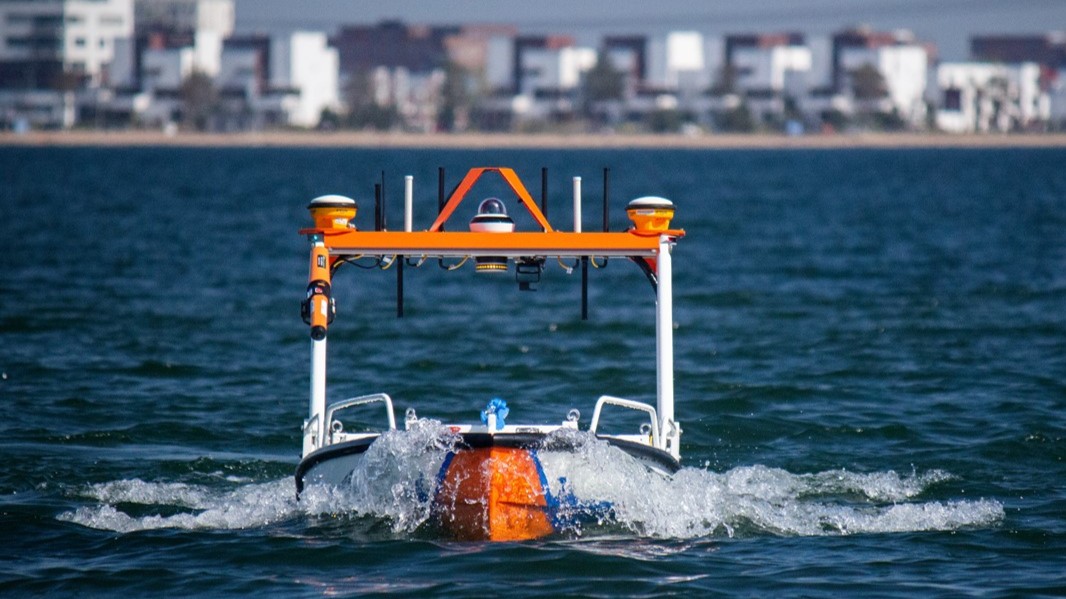
Can autonomous ships save energy by sailing in formation? And can they do this in a safe and reliable way? On July 6th, Xin Xiong, PhD candidate at the Department of Maritime & Transport Technology of SMASH partner Delft University of Technology, will defend his doctoral thesis. His study, under guidance of dr. Yusong Pang and prof. Rudy Negenborn (TUDelft), developed a hydrodynamics-aware model predictive control framework that enables multiple autonomous vessels to sail safely in formation, taking into account how vessels influence each other through the water. And yes, he also discovered that sailing in formation will save energy.
Originally from Wuhan, China, Xin came to the Netherlands four years ago to pursue his PhD in Maritime Technology. A recommendation from a former classmate, combined with his ambition to study at a well-established maritime research group, brought him to Delft. There was another motivation too: the opportunity to live and travel in Europe.
Birds in V-formation
Xin is a firm believer in the future of autonomous shipping. During his master’s studies he focused on the control of individual vessels. For his PhD, he was challenged at the Researchlab Autonomous Shipping of TUDelft to take the next step by exploring how multiple autonomous vessels could work together safely and efficiently. The inspiration for this came from nature. “Birds fly in a V-formation because it helps them save energy. Cyclists ride in groups for the same reason, and trucks can reduce fuel consumption by platooning. I wanted to investigate whether ships could benefit in a similar way.” Unlike birds or trucks, ships interact through water. As vessels sail close to each other, they create waves and water movements that influence neighbouring vessels. These interactions can either increase or decrease the energy needed to sail, depending on how the vessels are positioned. Understanding and using these effects formed the basis of Xin’s research.
His research focused on three main subjects. First, the way ships influence each other through the water. Second, the sailing formation, speed and distance that helps reducing energy consumption. And finally, a control system that keeps the ships in the desired formation while respecting wind, waves and currents that influence the movement of the ships.
Energy reduction
Xin first spent more than a year studying ship hydrodynamics and developing mathematical models that describe how vessels affect each other. He then combined these models in one formation control framework with the model predictive control method. After that he added an optimisation layer that allows the system to adapt to changing conditions and select the most energy-efficient configuration. The simulations produced promising results. Depending on the situation, formations such as a diagonal arrangement or sailing in line can reduce energy consumption by around 4 to 5 percent compared to vessels sailing individually in the considered simulation scenarios. The optimal formation depends on factors such as the type of waterway, vessel characteristics and environmental conditions.
Maritime research
Xin’s research at the Researchlab Autonomous Shipping at TUDelft contributes to the future of smart shipping. As autonomous and semi-autonomous vessels become more common, coordinated sailing could make inland shipping more sustainable without compromising safety. His new control framework helps vessels not only navigate independently but also cooperate intelligently, making better use of the natural interactions between ships. After defending his thesis, Xin will return to Wuhan to continue his career in maritime engineering and smart shipping research.
Invitation to the PhD defense:
You are welcome to attend the PhD defense of Xin Xiong:
Date: Monday, July 6, 2026
Time: 12:30
Location: Senaatszaal, Aula Conference Centre, TU Delft
Livestream: https://nmclive.tudelft.nl/mediasite/play/66e72339b2184cf2bceb585b5217ecbc1d